
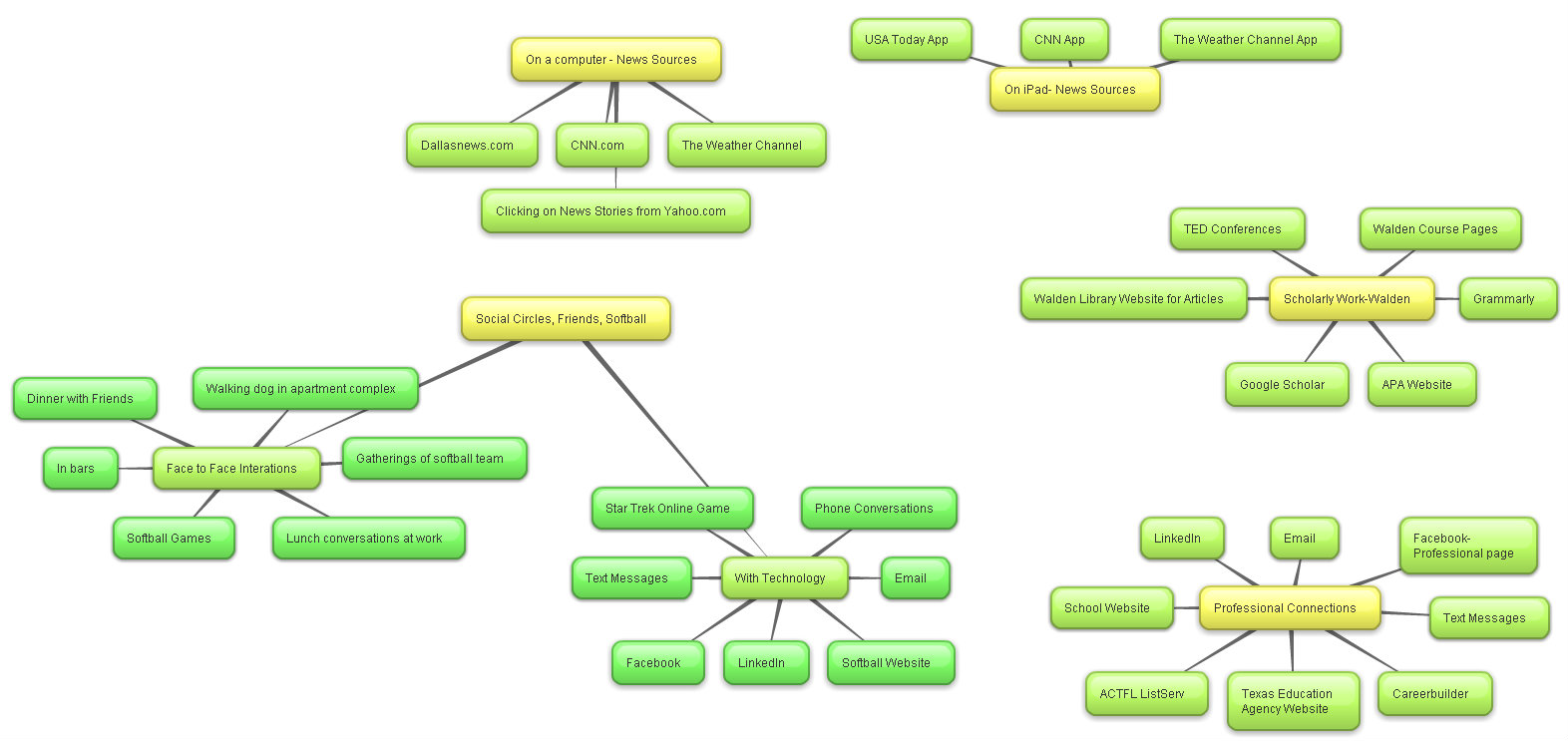
 As we learned in this module, individuals form connections to acquire information from a variety of sources. The ways individuals connect to these networks of information are as unique as the individual. If you were to compare my network of connections to that of a younger or older person, or someone without technology in their lives, you would see vast differences. To complete my mindmap of how I connect to networks, I divided my life into my main uses of time: Social, professional, scholarly (or my work at Walden), news sources while on a computer, and news sources while on my iPad. Since the original mindmap is quite large, I cropped the main sections so they would fit better for this format. If you would like the original file of all of these areas, please click here Large MindMap.
 One of the main ways I spend my time at work and at home is looking at the current news. I look for local stories, national news, and sometimes international news of places I am interested in (e.g. Spain, Argentina, France, etc.). I stopped watching television news about five years ago due to the often obvious slant on many news stories. Some news networks were clearly providing a liberal spin while others had very conservative views. I never felt like I was getting the whole story without bias or sensationalization. Take the current news of Trayvon Martin and George Zimmerman, for example. The media has put a spin on the story either by creative editing, showing pictures that are deliberately old, or presenting pictures that just are not the individuals. I lost trust in many of the news outlets due to their reporting skills and lack of relevant news (e.g. The Kardashian wedding), so I search on my own for information about stories of interest to me. The sources I use for my news fix while on a computer are Dallasnews.com, CNN.com, links from Yahoo.com's news section, and the Weather Channel. While each source may have weaknesses, the combination of these helps me form a balanced view of local, national and international news.
 When I don't have access to a traditional computer, I use my iPad to access news. I have downloaded the USA Today, CNN.com, and Weather Channel apps to get my news when I don't want to visit traditional web sites. I don't read the USA Today web site, but found that I enjoy the app because it allows me to view sections such as travel, world, sports, and money without having to search for specific items on a web site. The apps for the CNN and the Weather Channel also provide an intuitive layout for the news I seek. I can get just what I want, when I want it, without having to put forth a lot of effort through searching, typing, etc.
 I have more variety in my connections with professional content. As a Spanish teacher, I work with a department of 4 other teachers and we connect via email, text messages, and in person. We often discuss lesson plans, student progress, and ideas for how to teach difficult content. One teacher and I also use Facebook to connect with each other and with our students. Don't worry, this Facebook page is just school-related and only is used to inform students of assignments, offer teacherly advice, etc. I also access content from the Texas Education Agengy website for help with connecting my content to the content knowledge and skills required by the state. I am a member of various listservs where other teachers connect for ideas and share how they teach. My school website offers me information about schedules, testing events, and other daily operations knowledge I need as a teacher. Finally, I am looking for a new career that combines my passion for teaching with corporate training or travel. To that end, I am becoming more connected to sites like LinkedIn and Careerbuilder. I am trying to connect with employers that have the desired jobs I seek.
 The largest amount of diversity in my connections comes with my social group. With a unique group of friends and family members, I cannot just use one or two methods of communication or connection. For example, with my mother, I might use the phone to call her, text her, send her messages on Facebook, or have a face to face interaction. With a specific friend, Jenifer, I only text her now because we no longer work together. We rarely connect using phone coversations or have lunch like I do with my colleagues. I keep abreast of her life events (e.g. having a baby, moving, looking for a job) via Facebook and sometimes send her funny pictures via SMS messages.
 Finally, my scholarly work with Walden has me connecting with mostly scholarly sites such as the Walden Library or the course pages for each of our classes. Sure, I often go to other sites which have the resources or required readings, but when I map out how I access content, I usually go straight to the Walden site, access my couse information, and then seek out the resources via the library. Something I noticed that is quite different is that I do not use the phone, text messages, or Facebook when seeking out information. I do not socialize with most of the colleagues at Walden because I never seem to have the same people in my classes. Often times, I feel we are stressed trying to get the work done that we do not participate in the social aspect you might find in a face to face class. Sure, I see some people from time to time in classes, but I usually do not recognize names and do not make a concerted effort to mingle outside of the classroom.
So, how has my network changed the way I learn?--Well, in the past, I was reliant on newspapers and televised newscasts to get information pertinent to my local area. Sometimes there were national and international stories, but not as often. I had to get snippets of news that could fit into 30-60 minute broadcasts and did not go in-depth into the issues. Now, with my network of websites both on the computer and iPad, I can find stories of interest to me and if I choose, dig deeper by searching on the internet. With formal learning, I have a greater access of scholarly journals where I can draw information. By having websites that compile all of the literature I need, I no longer spend hours looking for sources, I spend seconds or mere minutes. I have gotten efficient at finding what I need, skimming the content for applicability, and storing the information for future use. This comes at little or no expense, which is much different from the days of microfiche and copies that I could not afford.
What tools work best for me?--The digitial tools that work best for me are my iPad and my home computer. The iPad provides all of the tools I need to connect with others. I can chat, send messages, search for news, access coursework, and just about anything I need to acquire knowledge, without being tethered to a computer. If I go outside and see something I don't know about (say a scary looking spider), I can immediately look up information and know if I need to run or just ignore it. With the computer though, I can generate content based on what I searched for. I use the traditional computer to apply, synthesize, and create material to make the content more meaningful for me.
How do I seek new knowledge?--I make no excuses, but when I want to find out information about a topic, I do a Google or Yahoo search. Based on the results presented, and avoiding the paid placements, I find the information I need, or look deeper. Two days ago a colleague mentioned the dangers of High Fructose Corn Syrup and that "research has shown...." As soon as I hear, "research has shown," I get suspiscious and look up relevant information so that I can judge for myself the merits of the argument. All of this investigation starts with a simple search engine query.
I also do the same for some of my work at Walden. If presented with a learning theory I know little about, the first thing I do is look it up for a summary. Then, based on the little bit of information I found, I continue to look for more sources, including from our library website. Sure, Wikipedia comes up, but I use it only to give me some basic knowledge before I try to get a deeper understanding.
Ray


